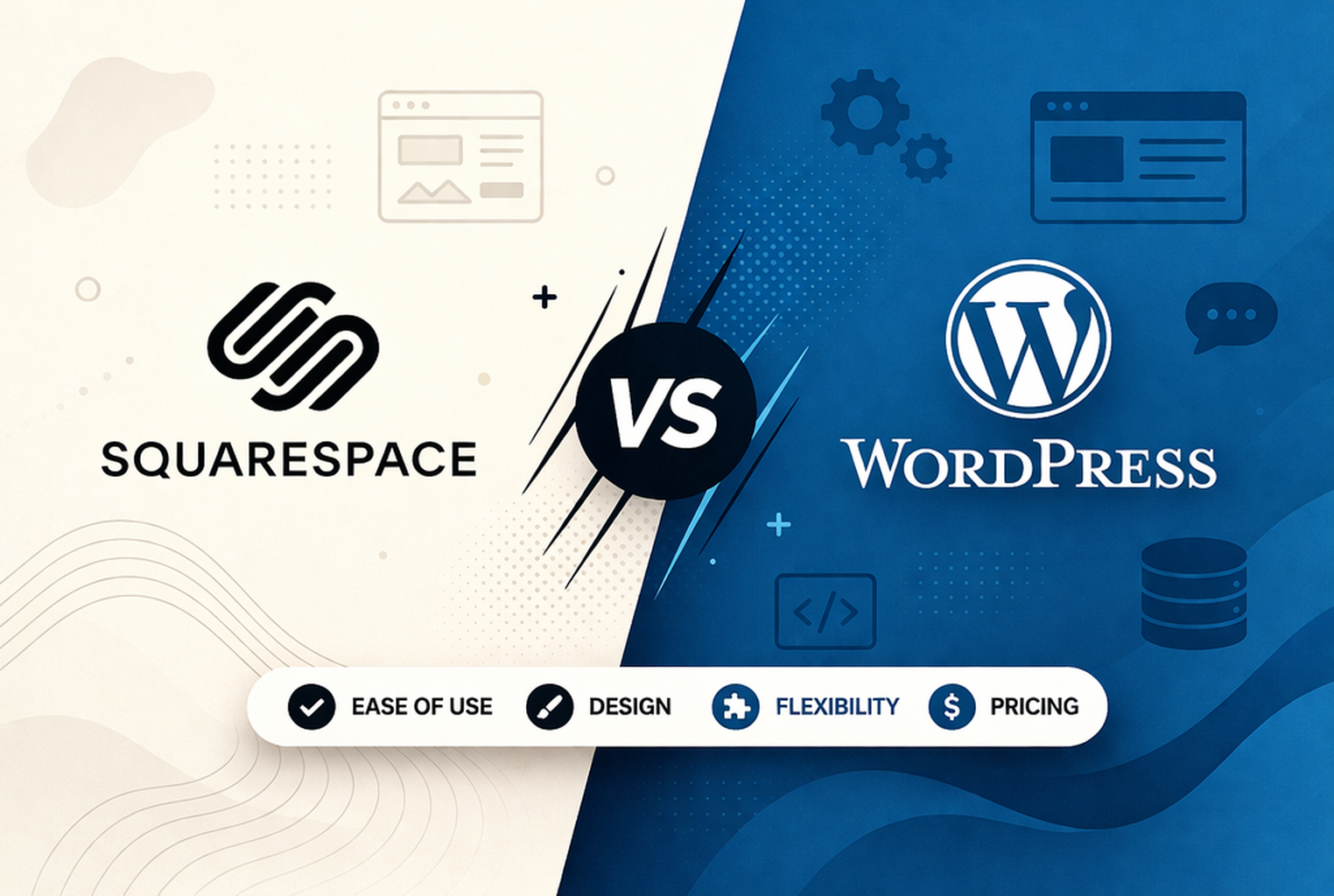
Choosing between Squarespace and WordPress is one of the most consequential decisions in a website project. The quick answer: Squarespace is the better choice for most service businesses, creatives and small stores. WordPress earns its place for large content operations and businesses with genuinely custom needs and the technical resources to match.
Two fundamentally different models
Squarespace is software as a service. One subscription covers hosting, security, updates, design tools and 24/7 support. Think of it as leasing a car with all maintenance included: you drive, they handle everything under the hood.
Self-hosted WordPress is free software you run yourself. You choose and pay for hosting, install security and backup plugins, keep the core, theme and plugins updated, and troubleshoot conflicts when they happen. You own the car, and every repair is yours.
Ease of use
Squarespace takes an hour or two to set up, a few days to feel natural, and minutes per week to run. WordPress takes hours to set up properly, weeks to feel comfortable, and 30 to 60 minutes a week of updates, backups and housekeeping. Most owners either invest that time or pay a developer to.
Design
Squarespace offers around 160 templates, and every one of them is professionally designed. Customization is deliberate rather than unlimited, which is exactly what keeps quality consistent. WordPress offers more than 10,000 themes of wildly variable quality: with a skilled developer the ceiling is unlimited, without one it is easy to end up with a dated theme fighting a page builder.
The true cost of ownership
This is where comparisons usually mislead. Squarespace costs $276 to $500 per year all-in for a typical service business, predictably. WordPress software is free, but realistic setups land elsewhere:
- Bare DIY: $180 to $300 per year on budget hosting with free plugins, paid for in your time, slower performance and security risk.
- Professional setup: $600 to $1,500 per year with quality hosting, premium plugins and occasional developer help.
- Fully managed: $1,500 to $3,000 per year once someone else carries the maintenance.
For a business that values its time, the free platform is rarely the cheap one.
SEO: myth versus reality
The persistent myth is that WordPress is better for SEO. In practice both platforms rank well when set up correctly. Squarespace covers titles, metas, sitemaps, clean URLs, structured data and Search Console integration out of the box, which is 90% of what most businesses ever need. WordPress offers deeper technical control that genuinely matters for operations with thousands of pages and a dedicated SEO team. Rankings are decided by content, backlinks and user experience, not by the platform badge.
Ecommerce
Squarespace ecommerce is clean and integrated, and comfortable up to a few hundred products, with subscriptions, digital delivery and point of sale built in. WooCommerce scales further but stacks up extension costs and technical complexity quickly. Honestly: for a serious store we usually recommend neither, but Shopify. Read our Shopify vs WooCommerce comparison if the store is the core of your business.
Support and security
When a Squarespace site breaks, one accountable company fixes it, around the clock, and security, backups and updates are entirely managed. The WordPress ecosystem is fragmented across host, theme and plugin vendors, where problems become "a plugin conflict, talk to your host", and security is your responsibility on the most attacked platform on the web. Unmanaged WordPress sites get hacked every day; recovery means hiring help.
Which should your business choose?
- Service businesses, consultants and agencies: Squarespace. Clean design, easy updates, no maintenance burden.
- Creatives, photographers and architects: Squarespace. The design quality is the point.
- Restaurants and hospitality: Squarespace. Menus, reservations and mobile come standard.
- Course creators and coaches: Squarespace. Member areas and payments are built in.
- Serious ecommerce: Shopify first, then WooCommerce if you have specific needs and a developer.
- Large publishers and custom platforms: WordPress, with the technical resources to run it properly.
Most businesses overestimate how much customization they actually need. What feels like a custom-code requirement is usually a feature Squarespace already has.
The verdict
For the vast majority of businesses in 2026, Squarespace is the better choice: the right balance of design quality, ease, reliability and true cost. WordPress remains excellent where its control is genuinely needed and resourced. The real question is not which platform is better, but which one serves your business without consuming it.