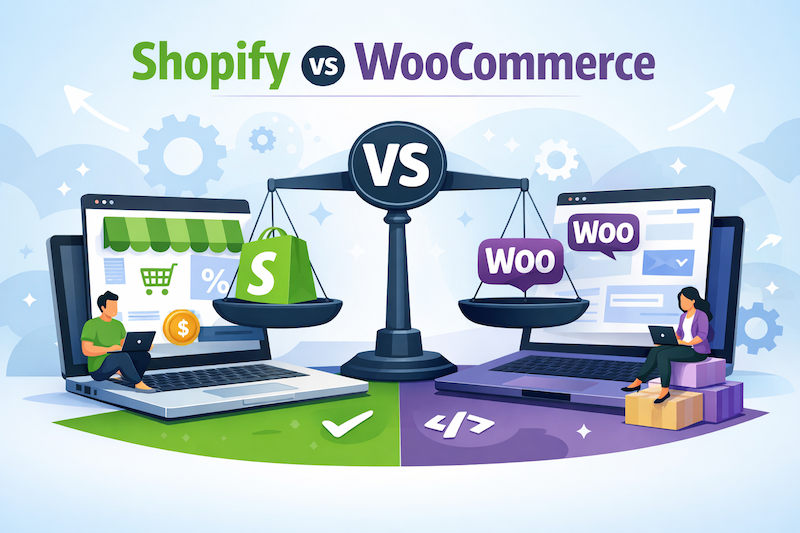
Two platforms dominate the ecommerce conversation for small and growing businesses: Shopify and WooCommerce. Both are powerful, both run millions of stores, and they are built for fundamentally different kinds of owner. Choosing the wrong one costs time, money and growth.
The core difference
Shopify is a fully hosted, all-in-one ecommerce platform. You pay a subscription and Shopify handles hosting, security, updates and infrastructure while you focus on selling. WooCommerce is a free plugin that adds ecommerce to a WordPress site: you own the code, pick your hosting, and carry updates, security and maintenance yourself, or pay someone who does.
The choice comes down to this: do you want a platform that just works, or total control with the technical responsibility that comes with it?
Ease of use
Shopify wins clearly. It is designed for non-technical owners: products, promotions and orders without touching code. WooCommerce demands more technical confidence, and progressively more as the store grows and plugins pile up.
Cost
WooCommerce looks cheaper because the plugin is free. Once you add hosting, a premium theme, security, essential extensions and maintenance, the totals are comparable and often higher, and far less predictable. Shopify starts at around €21 per month on annual billing with pricing you can plan around; the full breakdown is in our Shopify cost guide. WooCommerce hosting starts around €10 per month but rarely stays there once a store needs everything a store actually needs.
Performance and reliability
Shopify runs your store on its own infrastructure with a built-in CDN, automatic updates and 99.99% uptime. WooCommerce performance depends entirely on your hosting, your optimization and your update discipline. A busy store on a badly managed setup becomes slow and fragile exactly when it matters.
SEO
Both platforms rank well. WooCommerce, sitting on WordPress, offers slightly more plugin-level flexibility; Shopify's foundations cover meta tags, clean URLs, sitemaps and structured data properly. For most stores the difference is negligible, and content and backlinks decide the outcome.
Scalability and support
Shopify scales without drama: growing order volume is the platform's problem, not yours, and 24/7 support is included on every plan. WooCommerce can scale too, with active management and increasingly serious hosting, and when something breaks there is no single point of contact, only a host, a theme vendor and a dozen plugin authors.
When Shopify is the right choice
- You want to run your business, not technical infrastructure.
- You are launching your first store and need to move quickly.
- You sell physical products and need a reliable, streamlined operation.
- You want predictable monthly costs.
- You plan to scale and need a platform that grows without friction.
When WooCommerce is the right choice
- You already run a WordPress site and want to add ecommerce without replatforming.
- You have technical expertise in-house or a developer you trust.
- You sell digital products or content alongside physical goods and want WordPress's publishing strengths.
WooCommerce is a capable platform in the right hands. But "in the right hands" is doing a lot of work in that sentence.
The verdict
For the vast majority of product businesses, and especially fashion, lifestyle, beauty and DTC brands, Shopify is the stronger choice: faster to launch, easier to run, more reliable at scale, at a comparable true cost. If you do not have a developer on hand, WooCommerce means spending more time managing a website than growing a business.